

Over the past decades, I’ve had the good fortune to travel much of the globe pursuing my passion for landscape photography. I’ve made a particular effort to photograph the iconic locations in North America, and I thought I had seen everything on the “A List” years ago.
But I was wrong, because I recently visited Heart Lake for the first time, and it is clearly one of North America’s premier landscape photography locations. This diminutive alpine tarn in northern California is about as good as it gets.

Apparently, I’m not the only one of us who hadn’t yet ‘discovered’ Heart Lake because when I Googled “Heart Lake Photo Tips,” there wasn’t much to see. So I’ll address that shortcoming in this blog so you can make the most of your own visit here.
Location
One reason many photographers aren’t familiar with Heart Lake is probably due to it being a bit out of the way. Located near Mt. Shasta in Northern California, it’s only about 60 miles from the Oregon border, and the nearest big airport is 3 hours south in Sacramento. However, once you reach Mt. Shasta, it’s only a 20-minute drive to the trailhead located at Castle Lake (Google Maps or Waze will take you right to it).
Snow Warning
The road up to the trailhead (Castle Lake Road) closes after the winter snows hit (usually about the first of November). It usually reopens by late May, but that date depends on the amount of snowfall and the rate of snowmelt. Before planning a trip, check to make sure the road is open. This link will allow you to check for road closures.
The Hike
Castle Lake is a recreational area with picnic tables, fire rings, and vault toilets. It is popular, and the parking lot can be packed during peak hours.
The trailhead is located on the south side of the parking lot. The hike is about 1.5 miles/2.4 km (3 miles round-trip) with a 600′ elevation gain. It’s not a flat walk on a paved surface and is considered “moderate.” With that said, I’m in my mid-60s and it didn’t present much of a challenge.
Most folks can easily hike to Heart Lake in less than 90 minutes. After the first ten minutes, you climb past the treeline, and the trail becomes increasingly difficult to follow. You will need a GPS trail app to stay on track and avoid confusion due to the numerous ‘social trails.’ I used AllTrails and it got me straight there with no problems.
There is no food or (treated) water at Castle Lake or on the trail, so bring your own.
If you want to shoot sunrise or sunset and don’t like hiking in the dark, dispersed camping is permitted at Heart Lake (as of July 2025). Otherwise, check out my blog about night hiking.
What to Expect When you Get There
Heart Lake is smaller than you might think (about half the size of a football/soccer field). It’s situated in a ‘bowl’ surrounded by higher rocky ground on three sides. The “open” side faces north/northeast toward Mt. Shasta and provides the stunning perspective you saw above. Those surrounding heights reduce wind, so the lake is often calm (especially near sunrise/sunset)…which provides outstanding reflections.
During the summer, you are sure to see some folks at the lake. Most of them leave by sunfall, and you rarely see anyone at sunrise.
Shooting Locations
Heart Lake isn’t a ‘one-trick pony’ that offers only a single great shot. It has a number of excellent perspectives with quite a bit of difference between them. This map illustrates my four favorite spots.

- Location #1
There is a small rock ‘peninsula’ that juts out into the water from the 3 o’clock (east) position. As of May 2025, there was a half-submerged log right in front of it, providing a nice foreground element.

Tips:
- If you sink two of your tripod legs into the water, you can set your camera up only a foot over the water.
- A polarizer will ensure you can see the bottom of the lake in your image.

- Location #2
If you walk around to the back side of Heart Lake, you can get a shot of Mt. Shasta positioned in the center of the ‘infinity edge.’
Tips:
- Use a short telephoto lens at this spot.
- There is more water between you and the ‘edge’ here, so if there is any wind, you might want to try a ND filter to provide a longer exposure and smooth out any ripples.

If you climb 100′ up the hillside behind you at location #2, you can get the view shown below.

- Location #3
For a totally different perspective, head back toward spot #1 and then walk past it, heading right at Mt. Shasta for about a minute. Here, with Heart Lake right behind you, the landscape will fall away at your feet, revealing Castle Lake nestled below you and Mt. Shasta in the background.

Right in the center distance are the Black Buttes, a set of overlapping lava cones. They are substantial, stark, black, and quite striking. The shot below was taken here with the equivalent of a 100mm telephoto.

If you walk 100′ east from here, you come to the little stream that flows out of Heart Lake.

- Location #4
From Location #3, this spot is about .3 of a mile (.5 km) to the west along a ridge that rises 200′ from the side of Heart Lake. The ‘trail’ was largely invisible to my eyes and would have been difficult to find without the AllTrails App. It is marked “Lake View” on All Trails and should take you about 10 minutes to reach from the Lake.

As shown above, Location #4 (“Lake View”) gives you a significantly different perspective than Location #2, with Mt. Shasta solidly in the center of your frame. This is a particularly nice dawn spot and the rising sun will be visible on the right side of your image during most of the year.
Tips:
- You will need about a 16mm lens (on a full frame camera) to capture the whole scene. Or do a pano.
- The only downside of this location is that if you are there for sunrise or sunset, you won’t have enough time to also shoot from the other locations before the color passes its peak. It may only be ten minutes away, but the best color for sunrises/sunsets rarely lasts that long.
Bring your wide angle lens (many of my shots were taken at 16-40mm on full frame camera).
What to Bring
You will need a tripod, especially if you are going to shoot at sunrise/sunset. There is a huge dynamic range difference and you will need exposure bracketing to tame it.
You will also need a short telephoto, especially at location #2. Mt. Shasta is 16 miles away, and your telephoto will avoid the ‘lens compression’ effect that would otherwise make the mountain look smaller and less impressive. I’d suggest something that covers at least 70-100mm)
As previously mentioned, bring your polarizer to tame water reflections. Plus a ND filter will allow you to lengthen your exposures and smooth out any ripples.
While you are here…
There are some other great locations nearby that you should check out. Two that you shouldn’t miss are:
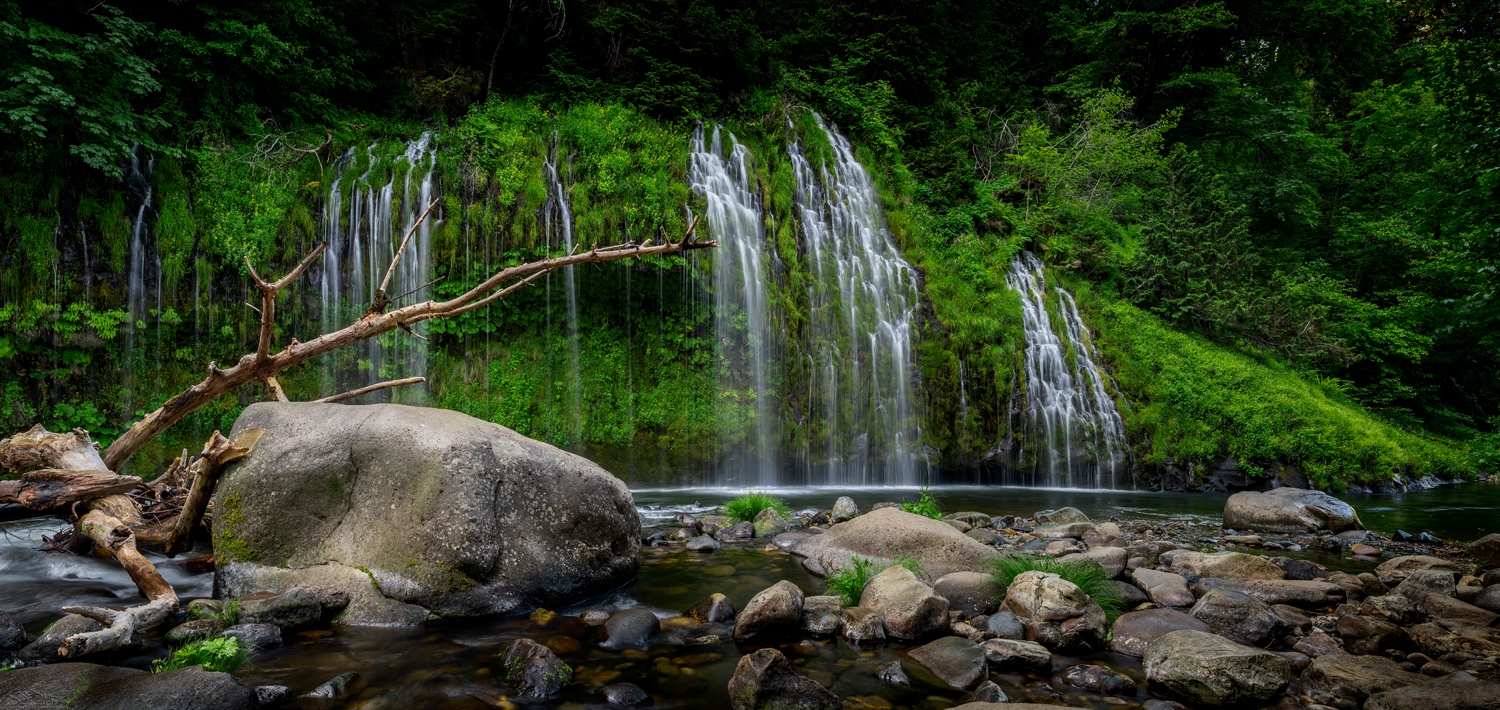
- Mossbrae Falls

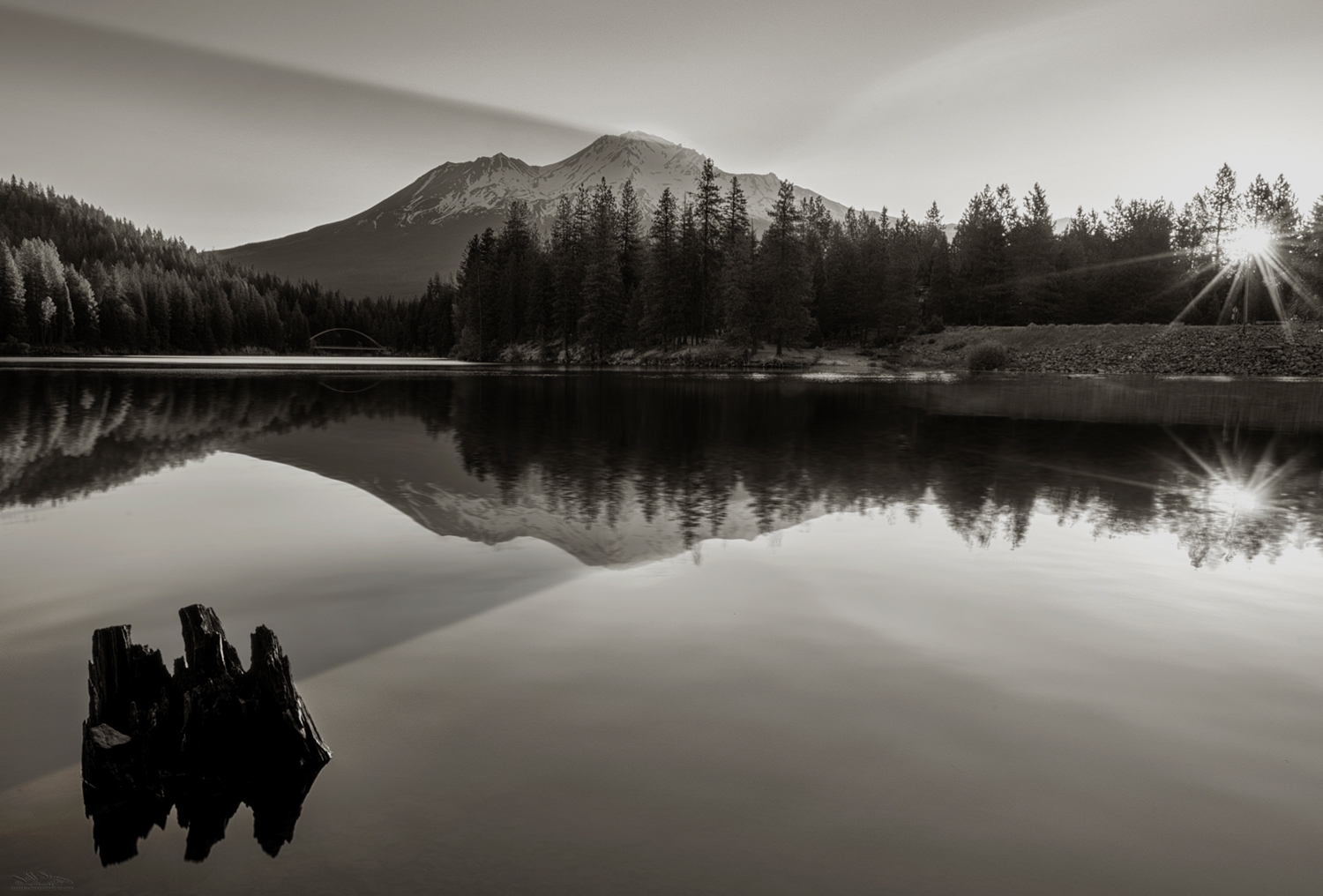
- Cable Beach at Lake Siskiyou has views like the one below less than five minutes from the parking lot

- Burney Falls, Castle Craigs, Hedge Creek Falls are also nearby, so there is plenty to occupy your camera for many happy hours.
And Now, for Something Completely Different
One of the things that I really love about photography, is that it gets me out of the house and allows/forces me to see more of the world. The hike back to my car provided a great example.
It was pitch black by the time I got started. Along the way, I turned a corner and came across this guy lying right across the path…

Normally, when I encounter a snake, I bid it hello (usually with a high-pitched squeal) and get the hell away, but this time, I hesitated, because this snake just looked ‘wrong.’

First of all, it had a blunt tail. I thought it had been bitten off, but when I took a closer look, there was no wound. And the skin…it looked ‘funny’, not like a normal snake. Anyway, my curiosity was so piqued that I pulled out my iPhone and took a couple of photos. Then, like a member of SEAL Team 6, I slowly, silently, and stealthily snuck my way around it.
When I got a cell signal a few minutes later, I looked it up on the internet. And learned that I had just had my first encounter with a California Legless Lizard. Which, to be honest, was something that I didn’t know even existed. Or like my son said: “Isn’t a legless lizard just the definition of a snake?”
Anyway, you just never know what you are going to see.
Cheers!
Jeff
If you want to see more shots from the area , check out more of my images from California and the nearby Pac NW

Related Images:

Views: 548